TBRL / DRDO Certification
The primary Indian government certification for all ballistic protection products procured by the Ministry of Defence, Ministry of Home Affairs and state police forces. TBRL conducts live-fire testing against specified threats and issues numbered test certificates. Required for all government and police tenders.
MHA Approved Vendor
SMI is listed on the Ministry of Home Affairs approved vendor list for ballistic protection equipment — a prerequisite for supply to central police organisations (CRPF, BSF, CISF, NSG, SSB) and state police forces under central government procurement programmes.
NIJ Standard 0101.06
The globally recognised standard for soft and hard body armour. Defines threat levels IIIA (pistol), III (rifle) and IV (armour-piercing). SMI body armour and hard plate inserts are tested to NIJ 0101.06 — the reference standard for international procurement comparison and export orders.
CEN EN 1063
The definitive international standard for bullet-resistant glazing and structural barrier products. Levels B1 (low-power handgun) through B7 (high-power rifle) are independently tested at European accredited facilities. SMI BR glass is tested to EN 1063 for international diplomatic and commercial projects requiring European standard compliance.
STANAG 2920
The NATO standard for ballistic helmet testing using V50 methodology — measuring the velocity at which a projectile has a 50% probability of penetrating the helmet. SMI helmets are tested to STANAG 2920 with V50 ≥ 610 m/s for the standard PASGT/MICH profile, qualifying for NATO member-country procurement.
NIJ Standard 0106.01
The NIJ standard specifically for ballistic helmets, defining protection levels and testing methodology including back face deformation limits. Complementary to STANAG 2920 — SMI helmets carry both certifications to satisfy both US-standard and NATO-standard procurement requirements.
CEN EN 1522 / EN 1523
EN 1522 covers bullet-resistant windows, doors, shutters and blinds as complete assemblies including frames and fixing systems — not just the glazing panel. EN 1523 covers test methods. SMI BR Sentry Cabins systems are tested as complete units to EN 1522 alongside EN 1063 glazing certification.
ISO 16933 / ASTM F1642
ISO 16933 defines test methods for blast-resistant glazing under controlled detonation. ASTM F1642 is the equivalent US standard used by embassies and government buildings under US State Department RSO requirements. SMI architectural blast glazing is tested to both standards as required by project specification.
IS 800 Structural Steel
All SMI structural steel products — observation towers, sentry post frames, anti-drone shelter frames and blast containment structures — are designed and fabricated in accordance with IS 800:2007 (General Construction in Steel), the Indian code of practice for structural steel design.
Independent.
No Exceptions.
All SMI certifications are issued by independent third-party testing bodies. We do not self-certify any product. Certificate numbers, test dates and issuing laboratory details are available on request for government procurement and audit purposes. Copies of current certificates can be provided under NDA for qualified procurement enquiries.
Ballistic Protection Levels Chart
Comparison of international standards (NIJ, CEN, STANAG) and corresponding ammunition threat levels for transparent and opaque armour.
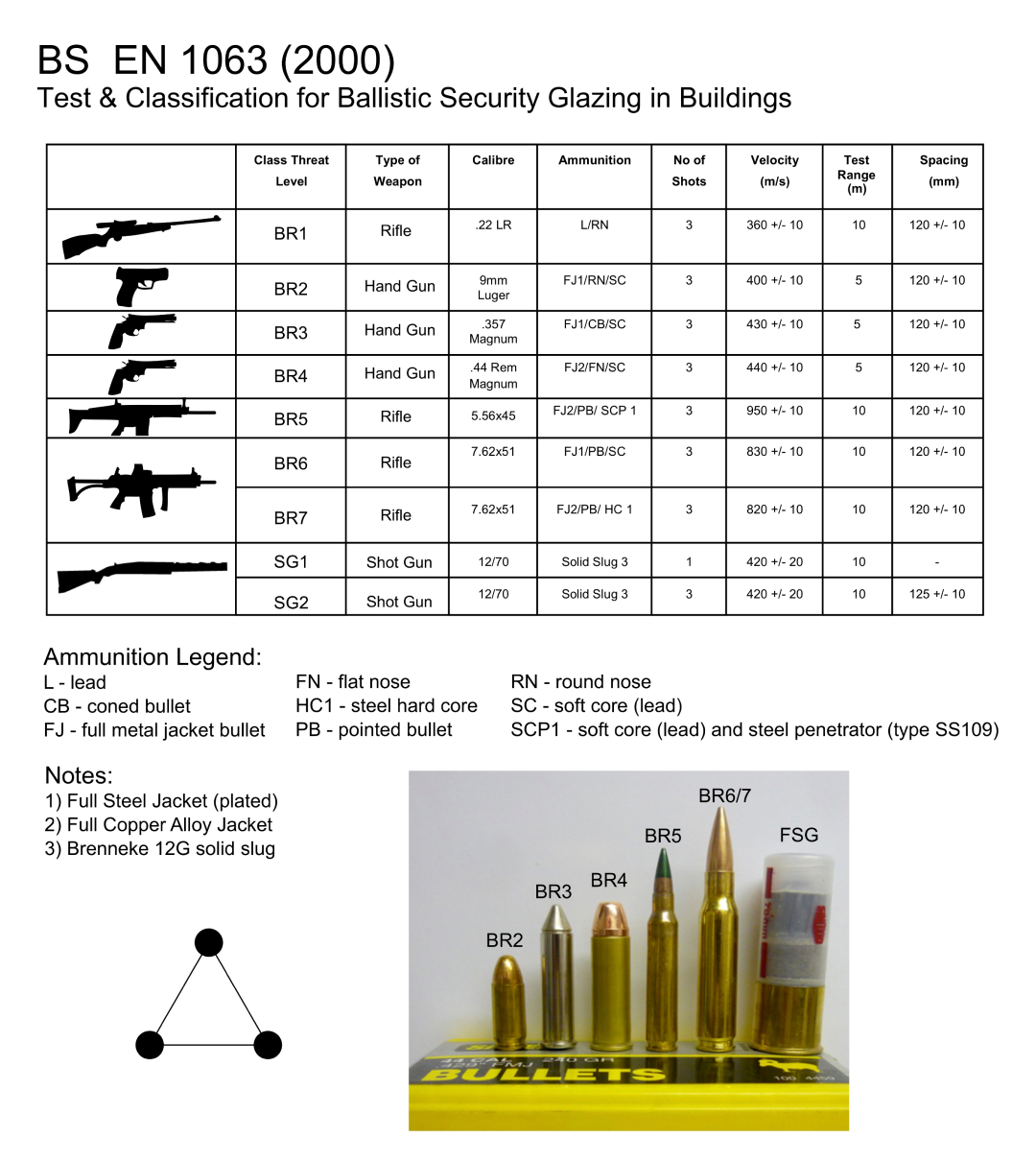
Click chart to view full size and compare threat levels